
Sentimental Value - Review
A less successful Joachim Trier film is still a pretty good film.

3.5/5
Families are weird. They’re complex, you’re stuck with them no matter what happens even whether they were there for you or not. In acclaimed filmmaker Joachim Trier’s latest Sentimental Value, he uses an absent auteur filmmaker father Gustav Borg (Stellan Skarsġard) to offer sometimes insightful sometimes straightforward truths on the trauma of parental absence and the forced isolation of art and the artist.
Borg is a much beloved director though he hasn’t made a film in some fifteen years. His daughter Nora (Renate Rinsve) is a respected theatre actor with troubling mental health. When we first meet her, she’s having a panic attack about going on stage but later in the film calmly explains how much she loves it and uses it as a vessel to channel emotion. She borderline hates her father who has always put his filmmaking before his family and we see through their stilted interactions, like a DVD with scratches on the disk, they just can’t seem to talk without a hitch or blip. On the flipside of the same coin is Borg’s second daughter Agnus (Inga Ibsdotter Lilleaas) who is trepidatiously warmer towards her father and a crucial comfort blanket to Nora. The sisters are close and leant a lot on each other growing up, warmly communicated by both actors. Agnus is a historian and happily married with a son, something Nora sees as beyond herself, perhaps due to her father’s absence. The film is tender in the way Trier can be, his direction impeccable and he can always mine subtle truths out of a simple look or interaction from his extremely talented cast. Sadly though, the script co-wrote with regular collaborator Eskil Vogt seems almost too mechanical, a set-up of characters who effectively yet unimaginatively competently deliver predictable themes.
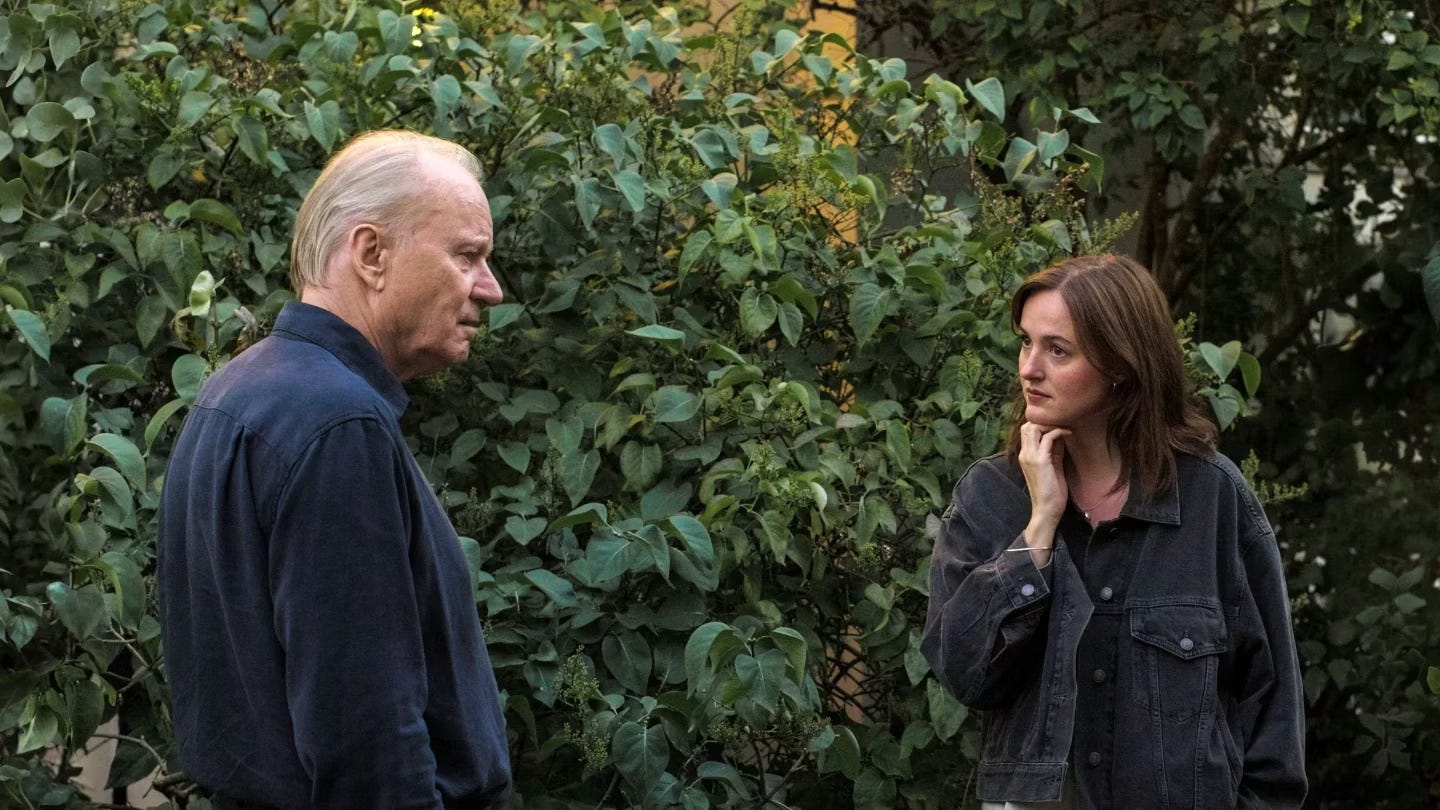
After their mother dies Gustav returns to the families childhood home and is forced to confront his relationship with his daughters. The house is portrayed as a character early on and Trier does an excellent job making the space feel alive with smart slow zooms and generation spanning, glimmering flashbacks. It turns out Gustav has written a new script, and he intends Nora to play the lead part despite their rift. After her refusal he meets superstar actor Rachel Kemp (Elle Fanning) at a screening of one of his career retrospective films and they decide to work together. Rachel’s striking resemblance to Nora not only adds a metacontextual element to the piece but her Americanisms and lapses in the Norwegian intricacies of Gustav’s script turn the film into a mirror of his life choices. He see’s writing a script for Nora as an extension of love in the only way he knows how but love always comes with a caveat with Gustav.
Sentimental Value knows exactly what it is doing and that is not necessarily a criticism. But by setting up these four characters in the way he does Trier somewhat writes himself into a corner. Each actor gives sublime performances Reinsve a charismatic yet depressive powerhouse on thin ice and emotional baggage too heavy for her to bear. Skarsġard a weathered soul weighing up his life and artistic choices as he approaches the end stage. Ibsdotter Lilleaas the fragile one keeping it all together with a son to look out for, forcing herself out of her grief-laden childhood in a way her sister can’t. Fanning as the well-meaning but slightly unaware superstar with an endearing conscious despite her celebrity quirks. These ingredients make for a nice meal but the artifice of the domineering themes surrounding parenthood, family trauma and memories through time and film never entirely evaporates.

Agnus acted in Gustav’s most acclaimed film as a child but quit the business early “It was the best time because I got to spend it with you” she laments to her father. This idea of only being able to truly spend time with your father on a set is rich and ultimately leads to a satisfying conclusion but doesn’t ring all that true for the rest of us. The film thankfully never unravels because of this, and Trier is too good of a filmmaker to let it engulf the material. There is plenty of sharp and sneaky connective tissue and it is still a marvel to see the film at work, even if it may not be something I’d take from my parent’s attic as a cherished souvenir.
Sentimental Value isn’t at the same level as Trier’s earlier work, but he still remains a master of understanding and explaining human behaviour.
Seen on 30/12/25 at Duke’s at Komedia.