
Deaf (Sorda) - Review
3/5

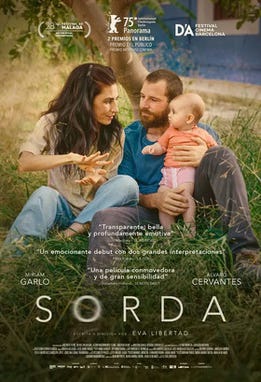
First time mothers have it tough no matter the circumstance but Eva Libertad’s feature debut Deaf invites us to experience birth and parenthood from a deaf woman’s perspective. Deaf representation on screen is few and far between and it’s refreshing to see a light shone on deaf processes from this angle.
Ángela (Miriam Garlo) is pregnant for the first time and has a loving, hearing husband Héctor (Álvaro Cervantes) who has devoted his life to her. He’s often the translator for the people she can’t communicate with, and he’ll cook her a lovely meal while dancing with her in the kitchen. There’s a sensitivity to their relationship enhanced by the two leads naturalistic performances. Garlo is a particular standout as a woman doing her upmost to find a happy medium between herself and the hearing world. Ángela is a determined and spirited woman who won’t take any flack, and Libertad directs with a soft touch that matches the nuance of the themes. Despite this Ánglea’s world is her own and only truly known by her caring group of deaf friends. While mostly able to communicate with her hearing family and friends there’s an inevitable level of disconnect. Especially with her fussy mother Elvira (Elena Irureta) who often devalues her independence. She’s distrusting and perhaps invertedly patronising to Ángela as opposed to if she were hearing – much like the rest of the world.
In terms of dramatic plot movement, the film is a quiet and ruminative portrait. The birthing scene of their daughter Ona is an anxiety inducing highlight. The incredible physical and mental stress the body is under is only amplified by the fact that Ángela never wholly knows what is going on. Doctors and nurses babble and fuss, some wear masks making it impossible to lip read and Héctor can’t always be there to interpret. This creates a catastrophic atmosphere where even if the birth is going to plan it feels as though someone’s pressed a panic button and Ángela’s watching on through impenetrable glass.
After the birth the quirks of new parenthood and the emphasis this puts on Ángela’s deafness takes centre stage. There’s that nagging feeling that she can’t connect with her child and maybe Ona doesn’t like her? Maybe she’ll never learn sign language? And is Héctor devaluing her in the face of a child he can more freely communicate? It’s delicate, well observed stuff but often the narrative feels meandering and difficult to penetrate. It’s a harder film to watch than it is to speak about, the ideas are there but it’s the slight presentation that will alienate certain viewers. However, patience is ultimately rewarded, and the film has new and important things to say about family and motherhood.
Ángela may feel like she’s doing something wrong, but it should never be in relation to her deafness. Deaf reminds us that the human spirit and the capacity to love is what makes a life, not any physical conditions.
Seen on 9/9/25 at Duke’s at Komedia as part of their “Discover” screenings.